
pTRAPPING takes the raw count data from a TRAP-seq or PhosphoTRAP experiment and finds which genes are specifically enriched in your cell population of interest — all in a few lines of R. You give it a counts table where every sample column is labelled with its treatment group, replicate number, and whether it is IP (immunoprecipitated) or INPUT (total RNA); the package figures out the rest. Three functions cover the full workflow: differential expression with your choice of statistical engine (ptrap_de()), a classic volcano plot for one condition (ptrap_volcano()), a paired scatter plot to compare two conditions head-to-head (ptrap_volcano2()), and a bubble plot to compare effect sizes and significance across treatments (ptrap_bubble()).
Installation
# install.packages("devtools")
devtools::install_github("laurenoconnelllab/pTRAPPING")
Dependencies from Bioconductor (edgeR, limma, DESeq2) are installed automatically.
Functions at a glance
| Function | What it does |
|---|---|
ptrap_de() |
Differential expression: IP vs INPUT. Six statistical methods. |
ptrap_volcano() |
Volcano plot for a single condition. |
ptrap_volcano2() |
Scatter plot comparing two conditions side-by-side. |
ptrap_bubble() |
Bubble plot of logFC and significance across treatments. |
Quick start
Get differential expression results of interesting genes from your counts matrix in just a few lines of code:
library(pTRAPPING)

# Load counts matrix
counts.mat <- read.delim(
  system.file("extdata", "TAN_etal_2016_raw.txt", package = "pTRAPPING")
)

# Table of differentially expressed genes of interest for one condition using the default method "LRT" from edgeR
ptrap_de(
  counts_mat = counts.mat,
  treatment_name = "PACAP",
  kable.out = TRUE,
  genes.filter = c(
    "Adcyap1",
    "Bdnf",
    "Ucn3",
    "Gng8",
    "Fosl2",
    "Junb",
    "Trappc12",
    "Gfap"
  )
)| Gene | logFC | logCPM | LR | PValue | FDR | treatment | diffexpressed |
|---|---|---|---|---|---|---|---|
| Gng8 | 4.056 | 5.578 | 39.952 | <0.001 | <0.001 | PACAP | UP |
| Ucn3 | 3.949 | 5.218 | 25.454 | <0.001 | <0.001 | PACAP | UP |
| Bdnf | 4.338 | 3.090 | 23.035 | <0.001 | <0.001 | PACAP | UP |
| Trappc12 | -3.345 | 1.809 | 10.679 | 0.001 | 0.030 | PACAP | DOWN |
| Gfap | -2.979 | 5.086 | 10.628 | 0.001 | 0.031 | PACAP | DOWN |
| Fosl2 | 0.781 | 6.990 | 3.694 | 0.055 | 0.304 | PACAP | NO |
| Adcyap1 | 1.516 | 3.665 | 2.708 | 0.100 | 0.398 | PACAP | NO |
| Junb | 0.757 | 4.568 | 1.385 | 0.239 | 0.600 | PACAP | NO |
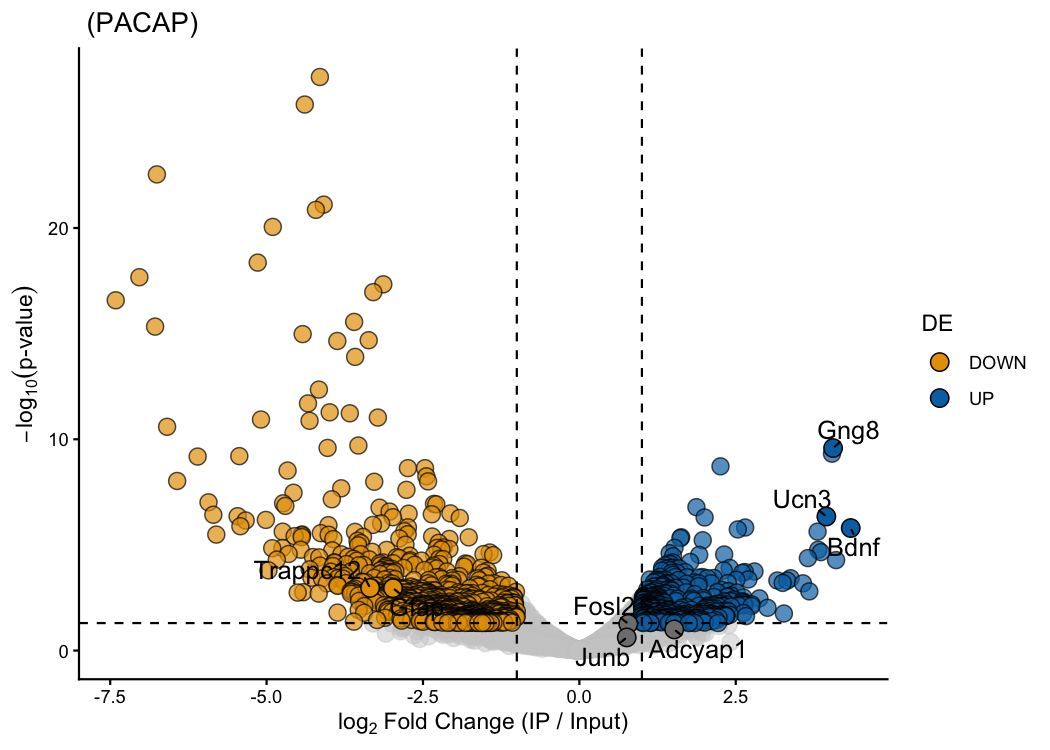
Plot the same results in a volcano plot and annotate any genes of interest:
# Volcano plot — label a few genes of interest
ptrap_de(
  counts_mat = counts.mat,
  treatment_name = "PACAP"
) |>
  ptrap_volcano(
    fdr = FALSE, # use raw p-values (n=3; FDR is very conservative)
    genes.annot = c(
      "Adcyap1",
      "Bdnf",
      "Ucn3",
      "Gng8",
      "Fosl2",
      "Junb",
      "Trappc12",
      "Gfap"
    )
  )
Or compare effect sizes across treatments with a bubble plot:
library(dplyr)
library(tibble)

# Pre-computed RPKM values
counts_rpkm <- read.delim(
  system.file("extdata", "TAN_etal_2016_RPKM.txt", package = "pTRAPPING")
)

genes_oi <- c("Adcyap1", "Bdnf", "Ucn3", "Gng8",
              "Fosl2", "Junb", "Trappc12", "Gfap")

prep <- counts_rpkm |>
  filter(if_any(where(is.numeric), ~ .x > 1)) |>
  mutate(gene = make.unique(Gene)) |>
  column_to_rownames("gene")

pacap <- ptrap_de(prep, test_method = "paired.ttest", norm.method = "none",
                  treatment_name = "PACAP", filter = FALSE,
                  lfc_threshold = 0.3, prior.count = 0,
                  genes.filter = genes_oi)

bdnf <- ptrap_de(prep, test_method = "paired.ttest", norm.method = "none",
                 treatment_name = "BDNF", filter = FALSE,
                 lfc_threshold = 0.3, prior.count = 0,
                 genes.filter = genes_oi)

bind_rows(pacap$results, bdnf$results) |>
  ptrap_bubble()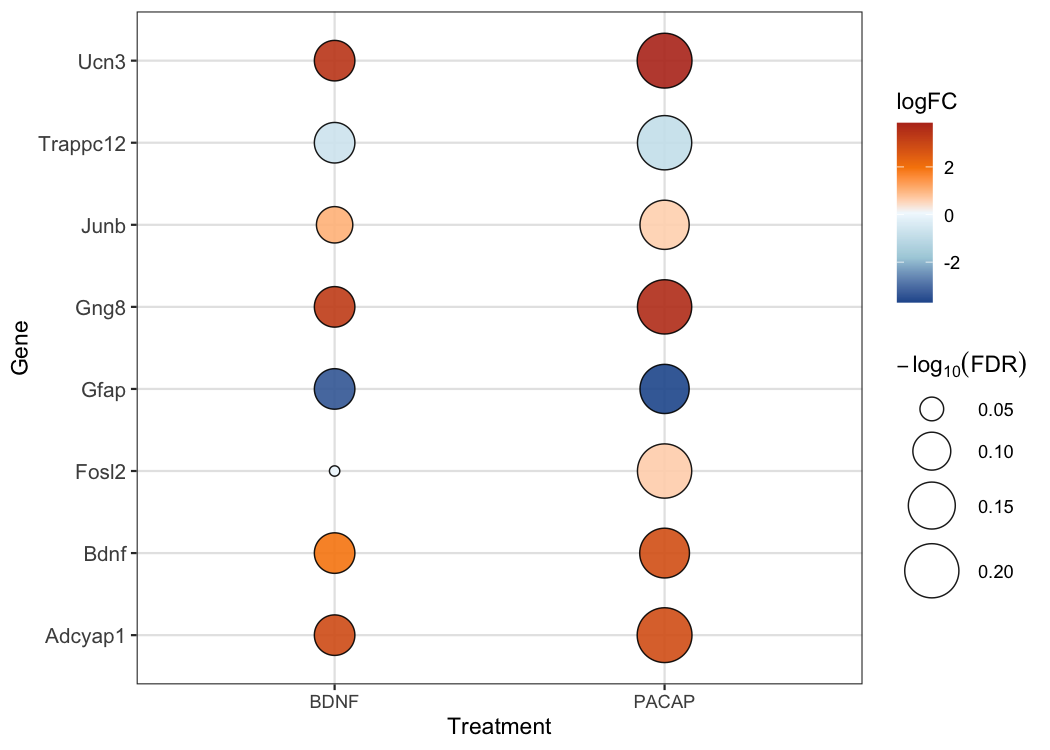
Check Getting started with pTRAPPING to see how to run the full workflow, including comparing two conditions head-to-head and making interactive volcano plots!
References
- The PhosphoTRAP method was introduced in:
Knight, Z.A., Tan, K., Birsoy, K., Schmidt, S., Garrison, J.L., Wysocki, R.W., Emiliano, A., Ekstrand, M.I., and Friedman, J.M. (2012). Molecular profiling of activated neurons by phosphorylated ribosome capture. Cell 151, 1126–1137. https://doi.org/10.1016/j.cell.2012.10.039
- Bioconductor packages used for differential expression analysis:
edgeR: Robinson, M.D., McCarthy, D.J., and Smyth, G.K. (2010). edgeR: a Bioconductor package for differential expression analysis of digital gene expression data. Bioinformatics 26, 139–140. https://doi.org/10.1093/bioinformatics/btp616
limma: Ritchie, M.E., Phipson, B., Wu, D., Hu, Y., Law, C.W., Shi, W., and Smyth, G.K. (2015). limma powers differential expression analyses for RNA-sequencing and microarray studies. Nucleic Acids Res 43, e47. https://doi.org/10.1093/nar/gkv007
DESeq2: Love, M.I., Huber, W., and Anders, S. (2014). Moderated estimation of fold change and dispersion for RNA-seq data with DESeq2. Genome Biol 15, 550. https://doi.org/10.1186/s13059-014-0550-8
- The example dataset is from:
Tan, C.L., Cooke, E.K., Leib, D.E., Lin, Y.-C., Daly, G.E., Zimmerman, C.A., and Knight, Z.A. (2016). Warm-sensitive neurons that control body temperature. Cell 167, 47–59. https://doi.org/10.1016/j.cell.2016.08.028